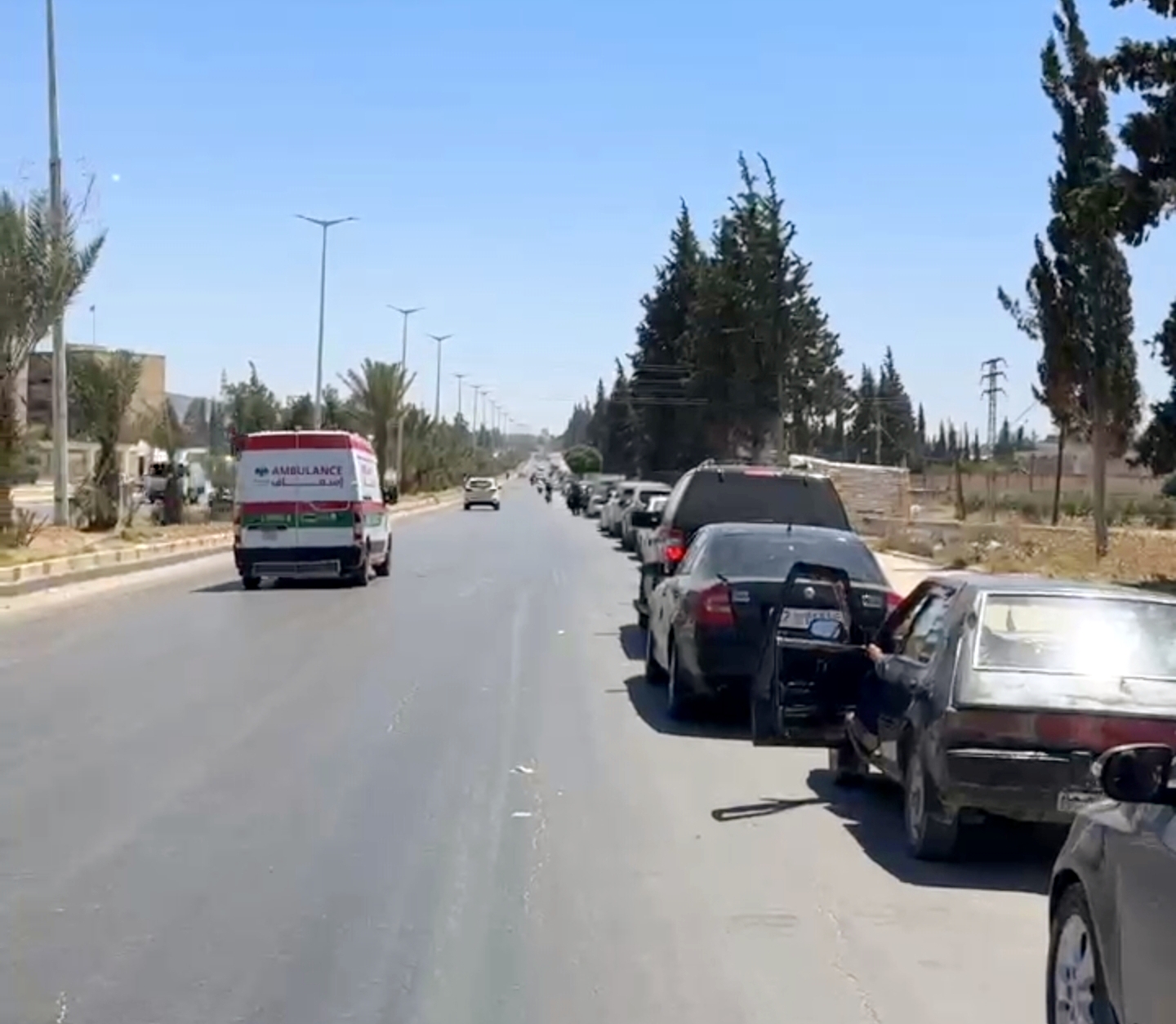

The new Hama…the new social fabric like you’ve never known before
Reporting by Yazan Shahdawi translated by Jihad Al-Haj
The issue of demographic change by the Syrian regime’s government in areas known to oppose it has become incontrovertible; it is cultivating supporters in all these areas in an attempt to impose demographic control over those areas to prevent the establishment of future opposition movements that could pose a new threat.
With the demographic changes formed by the leadership in Damascus after its near-total control of Syrian territory, the regime began to transform these areas into mixed-denominational and ideological areas, and rearrange their social fabric according to strategies developed for each region that ensured that there were supporters equipped for an upcoming opposition movement.
Systematic displacement within the truce
During the relocation of people from areas opposed to the Syrian regime’s government to the north, the first of which was in 2016, agreements were concluded between both armed opposition fighters, the Syrian regime government and The Lebanese Hezbollah with Russian mediation, to transport residents and fighters from conflict zones and regime forces’ control to Idlib province on the border with Turkey, as in damascus countryside, al-Waer neighborhoods in Homs and the southern countryside of Hama.
Through these agreements, the regime’s government sought to strip the population of their property and demographic identity and transfer it to other new places with decrees and laws formulated on the scale of the change required, all within the frameworks of the Constitution and laws.
The regime government began to impose its new strategies based on the settlement of its security groups and their families, as well as elements of the Lebanese Hezbollah and their families in these areas, and the allocation of property on official and legal property contracts, with the aim of permanent settlement, creating a modern social environment based on the 2016 plans of forced displacement of the population, and creating a new Syrian society that suits the requirements of the Syrian government.
Hama was one of the first areas that the regime has focused on since the beginning of the opposition movement against it to dismantle its social fabric known for its opposition to the Government of the Syrian regime for reasons related to what happened during the days of Hafez al-Assad in the 1980s, and began to facilitate the arrival of internally displaced persons and displaced persons to work to open this social fabric and facilitate its penetration and create this environment and settle hundreds of security elements, security officers and their families in different civilian neighborhoods within Hama and achieve a large spread within them.
Hama, once known as the closed society, was inhabited only by Sunnis and Christians in two neighborhoods of the city (the city and Sheikh Anabar), but today, in the wake of the population inflation in Hama, which reached more than 2.5 million people, you are beginning to see in each apartment building a family of security personnel serving in a branch of Hama, the military airport, the 47th Brigade and others. According to instructions given to them in early 2018 to settle within the city rather than within the Hama countryside, families from various other communities have begun to spread to neighborhoods and buildings like never before.
According to this plan, the city of Hama and its neighborhoods began to disintegrate slowly, especially after being free of its youth because of their daily travel to escape military service and for a better life, and the residents of the neighborhoods, especially those known as its opposition to the regime, began to fear the regime and raise pro-government banners and its decision, due to social mixing, which became an inevitable reality after their daily dealings with security and military personnel in the security branches, and thus the regime succeeded to a large extent in muting the voice of the opponents in Hama and ensuring that it is hidden within the security forces. Only the walls of houses, which most residents of Hama have come to notice that they are unable to express against any decision of the regime government due to the presence of thousands of security elements that are within the joints of their daily lives.
Many residents of Hama believe that it has become difficult for its social fabric to return to what it was, and the society in Hama has lost many customs and traditions, and the state of the city is like the other Syrian provinces, whose demographics have been successfully changed and ensuring that they remain under the mandate of the Government of the Syrian regime and suppressing the movement opposed for years and years.